HERMANNSDENKMAL
HERMANNS
DENKMAL
Immersive cultural landmark website

Hermannsdenkmal is a historic German landmark dedicated to Arminius and the Battle of the Teutoburg Forest. This concept transforms the website from a practical information source into an immersive digital entry point, where visitors can plan a trip, explore the monument in 3D and experience history through audio storytelling.
Hermannsdenkmal is a historic German landmark dedicated to Arminius and the Battle of the Teutoburg Forest. This concept transforms the website from a practical information source into an immersive digital entry point, where visitors can plan a trip, explore the monument in 3D and experience history through audio storytelling.
Hermannsdenkmal is a historic German landmark dedicated to Arminius and the Battle of the Teutoburg Forest. This concept transforms the website from a practical information source into an immersive digital entry point, where visitors can plan a trip, explore the monument in 3D and experience history through audio storytelling.
Year:
2026
Product type:
Website
Service:
Immersive Web Experience
Industry:
Culture & Heritage
current website
analysis
The website already provides useful visitor information,
tours, FAQ, news and a ticket shop, but key visitor actions
remain difficult to discover and navigate.
The website already provides useful visitor information,tours, FAQ, news and a ticket shop, but key visitor actionsremain difficult to discover and navigate.

1.overloaded hero section
The hero section uses a strong monument image, but the visual focus competes with multiple navigation elements, slider content, anniversary text and a generic “Mehr Infos” (More Information) button. As a result, the first screen does not clearly guide users toward the most important actions: planning a visit, buying tickets, or exploring the monument.
The hero section uses a strong monument image, but the visual focus competes with multiple navigation elements, slider content, anniversary text and a generic “Mehr Infos” (More Information) button.
As a result, the first screen does not clearly guide users toward the most important actions: planning a visit, buying tickets, or exploring the monument.
UX / UI issues:
Hick’s Law: too many competing elements
Cognitive Load: too much text at first glance
Visual Hierarchy: CTA is not dominant
Jakob’s Law: “Mehr Infos” feels too generic


2.fragmented visit planning
Visit-related content exists, but it is split across several navigation areas. Important actions such as opening hours, prices, parking, tours and the ticket shop are not presented as one connected “Besuch planen” (Plan Your Visit) journey. The ticket shop is especially difficult to discover because it sits inside the second level of the “Führungen” (Tours & Guided Tours) dropdown instead of being clearly connected to visit planning or ticket purchase.
Visit-related content exists, but it is split across several navigation areas.Important actions such as opening hours, prices, parking, tours and the ticket shop are not presented as one connected “Besuch planen” (Plan Your Visit) journey. The ticket shop is especially difficult to discover because it sits inside the second level of the “Führungen” (Tours & Guided Tours) dropdown instead of being clearly connected to visit planning or ticket purchase.
UX / UI issues:
Information Architecture: visit tasks are split
Recognition over Recall: Ticketshop is hidden
Goal-Gradient Effect: booking path feels indirect
Fitts’s Law: key actions are hard to reach
key takeaway
Useful content already exists, but key visitor actions are not visible or connected enough.
Planning a visit, finding tickets and choosing tours require extra navigation across separate areas.
The concept brings these actions into one clear journey and makes the website feel more focused, guided, and immersive.
Useful content already exists, but key visitor actions are not visible or connected enough.Planning a visit, finding tickets and choosing tours require extra navigation across separate areas.The concept brings these actions into one clear journey and makes the website feel more focused, guided, and immersive.

visit planning
felt fragmented
Goals
goals
Help visitors quickly plan their trip to the monument
Turn historical content into an engaging experience
Create a more immersive digital visitor experience
Constraints
History content and visit information
Mixed audience: tourists, families, and students
Need to keep immersive elements clear and usable
Success Criteria
Faster access to tickets, location, prices, and FAQ
Clearer monument understanding before visiting
Stronger engagement through audio and 3D
problems & solutions
problems & solutions
Problem
Problem
Information overload
Information overload
Information overload
Visitor details, history, tickets, and FAQ felt scattered.
Visitor details, history, tickets, and FAQ felt scattered.
Visitor details, history, tickets, and FAQ felt scattered.
Solution
Solution
Clear Visit Structure
Clear Visit Structure
Clear Visit Structure
Key visit details are grouped into clear planning sections.
Key visit details are grouped into clear planning sections.
Key visit details are grouped into clear planning sections.
Problem
Problem
Limited exploration
Unified Platform
Users could view the monument, but not inspect details.
Users could view the monument, but not inspect details.
Users could view the monument, but not inspect details.
Solution
Solution
Interactive 3D Model
Interactive 3D Model
Interactive 3D Model
Hotspots help users explore symbolic monument elements.
Hotspots help users explore symbolic monument elements.
Hotspots help users explore symbolic monument elements.
Problem
Problem
History felt distant
History felt distant
The story was informative, but not emotionally engaging.
The story was informative, but not emotionally engaging.
The story was informative, but not emotionally engaging.
solution
solution
Voice From the Past
Voice From the Past
Voice From the Past
Audio storytelling brings the historical context closer.
Audio storytelling brings the historical context closer.
Audio storytelling brings the historical context closer.
Problem
Problem
Unclear next step
Unclear next step
Tickets and visit planning needed a stronger action path.
Tickets and visit planning needed a stronger action path.
Tickets and visit planning needed a stronger action path.
solution
solution
Guided Ticket Entry
Guided Ticket Entry
Guided Ticket Entry
Clear cards and CTAs connect interest with booking.
Clear cards and CTAs connect interest with booking.
Clear cards and CTAs connect interest with booking.
from history
to immersion
The concept helps users experience the monument
before visiting through two immersive features: historical
audio narration and an interactive 3D monument model.
The concept helps users experience the monument before visitingthrough two immersive features: historical audio narrationand an interactive 3D monument model.

voice from the path
“Stimme aus der Vergangenheit” translates as “Voice from the Past.” It is an audio storytelling feature that lets users hear Arminius’ historical context instead of only reading about it. The section combines narration, translated text, and a custom audio player to make the monument’s story feel closer and more memorable.
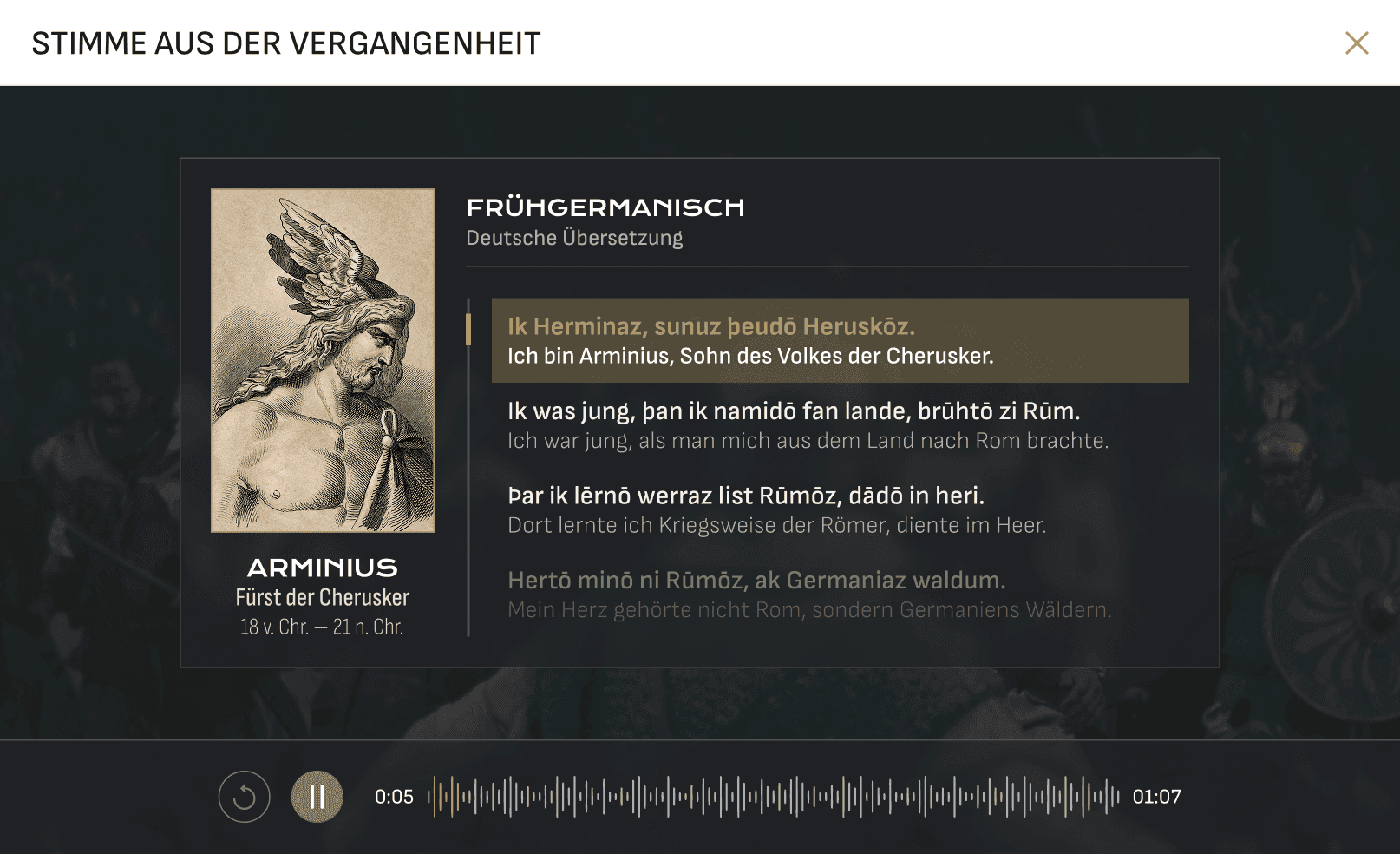

STIMME AUS DER VERGANGENHEIT
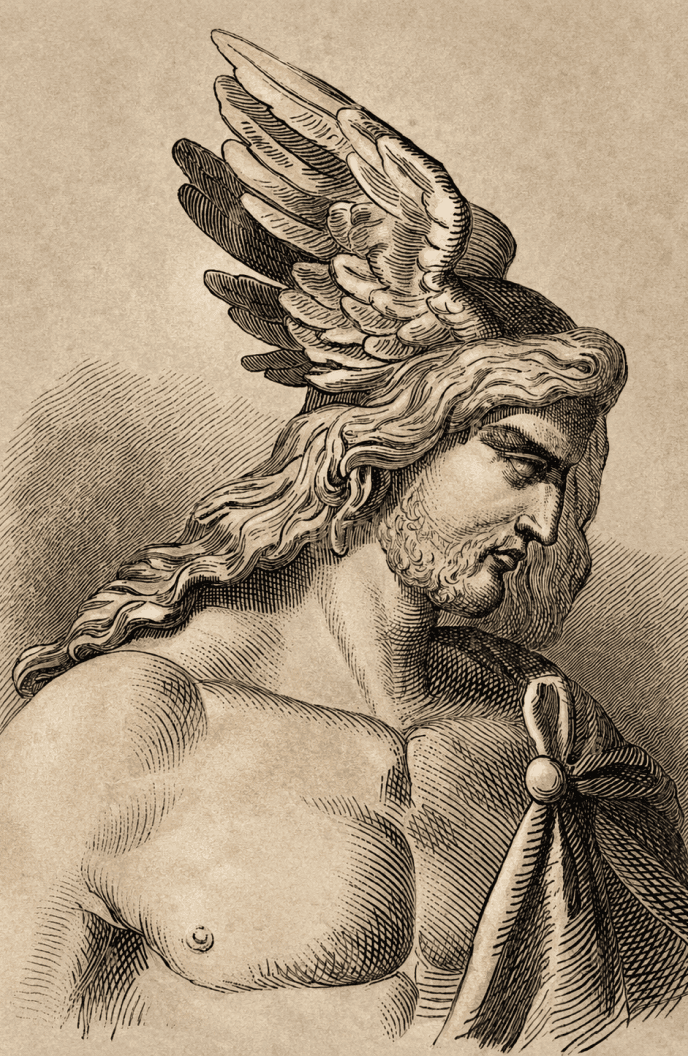
Arminius
Fürst der Cherusker
18 v. Chr. — 21 n. Chr.
Frühgermanisch
Deutsche Übersetzung
Ik Herminaz, sunuz þeudō Heruskōz.
Ich bin Arminius, Sohn des Volkes der Cherusker.
Jung ik was, þan man mik fan haimō zi Rūm nam.
Ich war jung, als man mich aus dem Land nach Rom brachte.
Þar ik Rūmōz werraz listō lernidō jah in heri dēnidō.
Dort lernte ich die Kriegskunst der Römer und diente in ihrem Heer.
Ik sah iro mahti, iro ordō jah iro strangō handu.
Ich sah ihre Macht, ihre Disziplin und die Stärke ihrer Legionen.
Ak hertō mīnō Germaniōz waldum hēld.
Doch mein Herz gehörte den Wäldern Germaniens.
Þan ik widar kwam, ik Heruskōz jah bundanō þeudōz samnida.
Als ich zurückkehrte, vereinte ich die Cherusker und unsere Verbündeten.
In dimmō waldu, bi Teutoburgō, þrī Rūmiskō legiōnōz fēllun.
Im Teutoburger Wald gingen drei römische Legionen unter.
Þar Rūmōz mahti brokan war, jah iro wegōz stōdun.
Dort zerbrach die Macht Roms und ihr Vormarsch kam zum Stillstand.
Rūmōz ni lengō Rīnō farþōn.
Von da an überschritt Rom den Rhein nicht mehr.
Sīgō sa ni bloz slag was. Frījadō þeudōz was.
Dieser Sieg war mehr als eine Schlacht. Er war die Freiheit unserer Völker.
3d model tour
“3D-Modell Entdecken” is an interactive 3D experience that lets users explore the Hermannsdenkmal from every angle. Visitors can rotate, zoom, and inspect the monument while discovering historical facts through interactive hotspots. The feature brings the landmark closer and makes exploration more engaging before the physical visit.
“3D-Modell Entdecken” is an interactive 3D experience that lets users explore the Hermannsdenkmal from every angle. Visitors can rotate, zoom, and inspect the monument while discovering historical facts through interactive hotspots. The feature brings the landmark closer and makes exploration more engaging before the physical visit.


from offer to booking
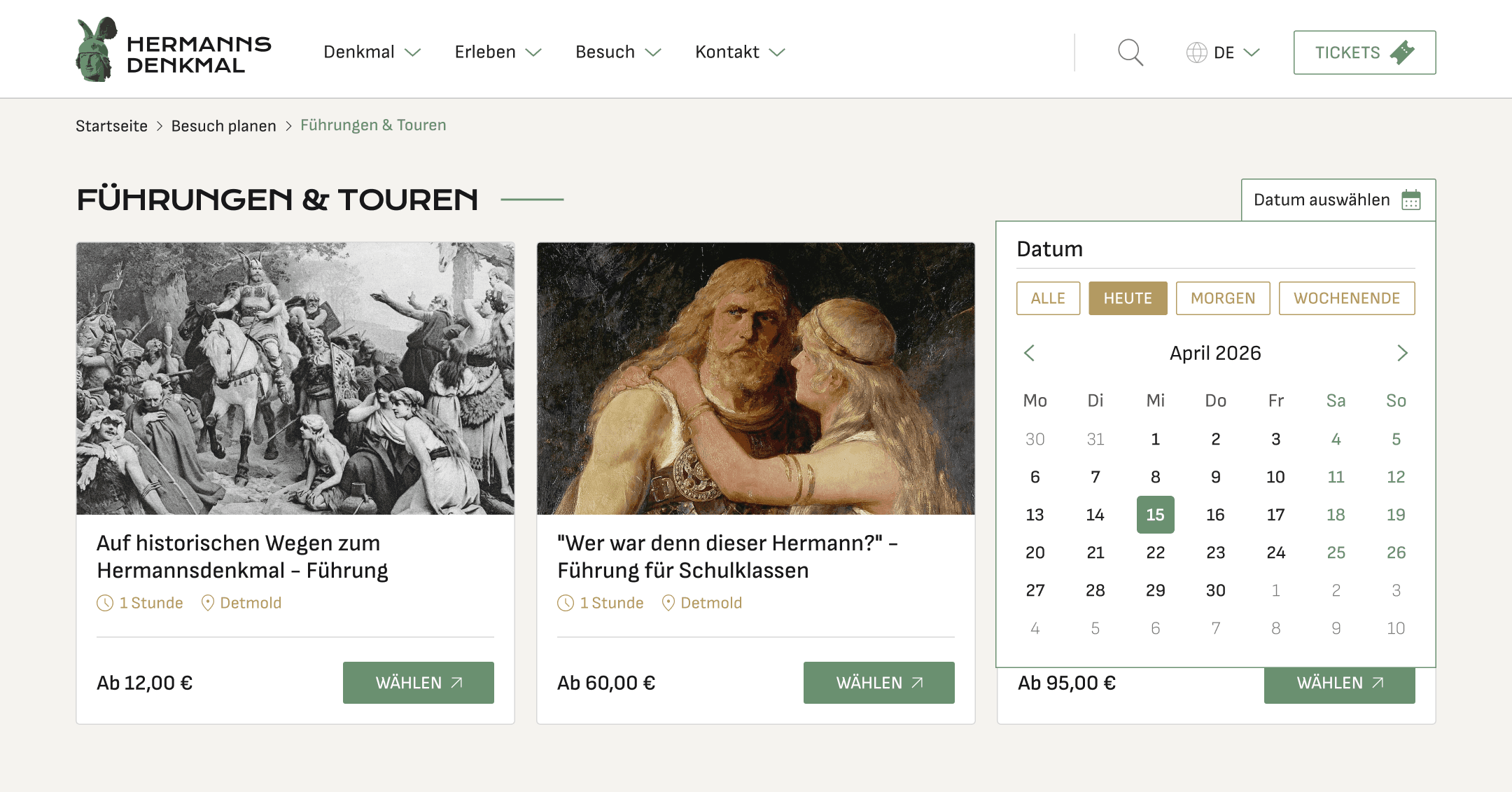
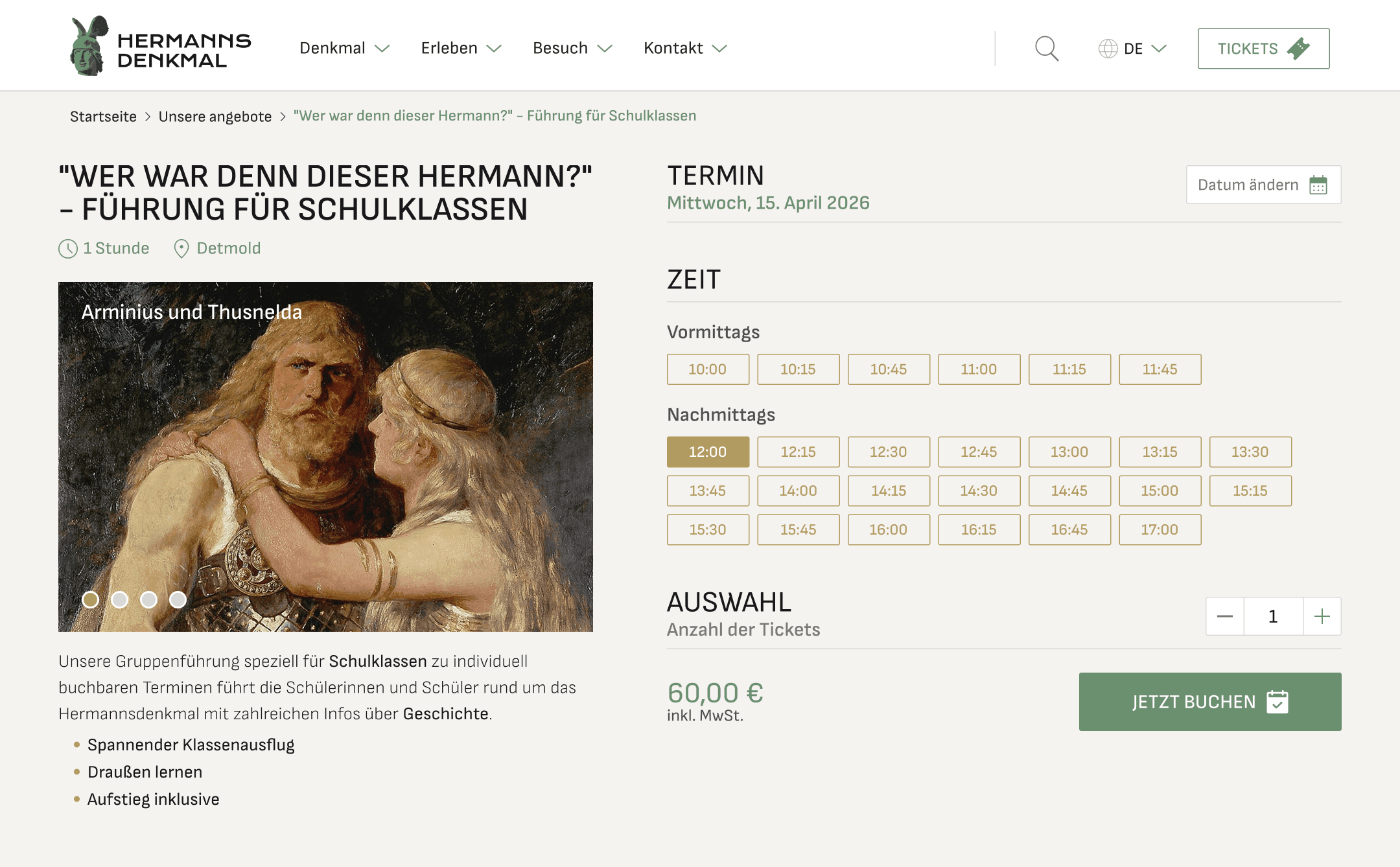
The flow connects offer selection, date filtering, time slots, ticket quantity, and final booking into one clear path.
Instead of searching across separate pages, users can move from interest to action with fewer steps and better orientation.
The flow connects offer selection, date filtering, time slots, ticket quantity, and final booking into one clear path.
Instead of searching across separate pages, users can move from interest to action with fewer steps and better orientation.
The flow connects offer selection, date filtering, time slots, ticket quantity, and final booking into one clear path.Instead of searching across separate pages, users can move from interest to action with fewer steps and better orientation.


key takeaway
The booking experience was redesigned around the visitor's primary goal: planning a visit with minimal effort.
By connecting offer discovery, date selection, ticket configuration, and checkout into one consistent flow, the concept removes unnecessary navigation and reduces cognitive load.
This creates a more intuitive path from first interest to confirmed booking, especially for first-time visitors.
The booking experience was redesigned around the visitor's primary goal: planning a visit with minimal effort.
By connecting offer discovery, date selection, ticket configuration, and checkout into one consistent flow, the concept removes unnecessary navigation and reduces cognitive load.
This creates a more intuitive path from first interest to confirmed booking, especially for first-time visitors.
The booking experience was redesigned around the visitor's primary goal: planning a visit with minimal effort.By connecting offer discovery, date selection, ticket configuration, and checkout into one consistent flow, the concept removes unnecessary navigation and reduces cognitive load.This creates a more intuitive path from first interest to confirmed booking, especially for first-time visitors.
core features
01
VISIT PLANNING
VISIT PLANNING
Opening hours, prices, FAQ
and tickets in one place.
02
3D MONUMENT VIEWER
3D MONUMENT VIEWER
Interactive hotspots help users explore monument details.
03
VOICE FROM THE PAST
Audio narration turns history
into a closer experience.
01
03
VISIT PLANNING
VOICE FROM THE PAST
Opening hours, prices, FAQ
and tickets in one place.
Audio narration turns historyinto a closer experience.
03
VOICE FROM THE PAST
Audio narration turns historyinto a closer experience.
03
04
Trusted Profiles
TICKET BOOKING
Credentials, approach, and clear session details.
Clear ticket cards guide users toward purchase.
04
TICKET BOOKING
Clear ticket cards guide users toward purchase.
04
TICKET BOOKING
Clear ticket cards guide users toward purchase.
05
HISTORY STORYTELLING
HISTORY STORYTELLING
Visual blocks explain context, symbolism, and meaning.
06
CULTURAL GALLERY
CULTURAL GALLERY
Editorial images show the place, views, and atmosphere.
selected
screens
Key screens showing how the project rethinks
the visitor journey - from first impression to planning,
booking and exploration.
Key screens showing how the project rethinksthe visitor journey - from first impression to planning, booking and exploration.
Key screens showing how the project rethinks
the visitor journey - from first impression to planning,
booking and exploration.


history through
digital experience
from monument to discovery
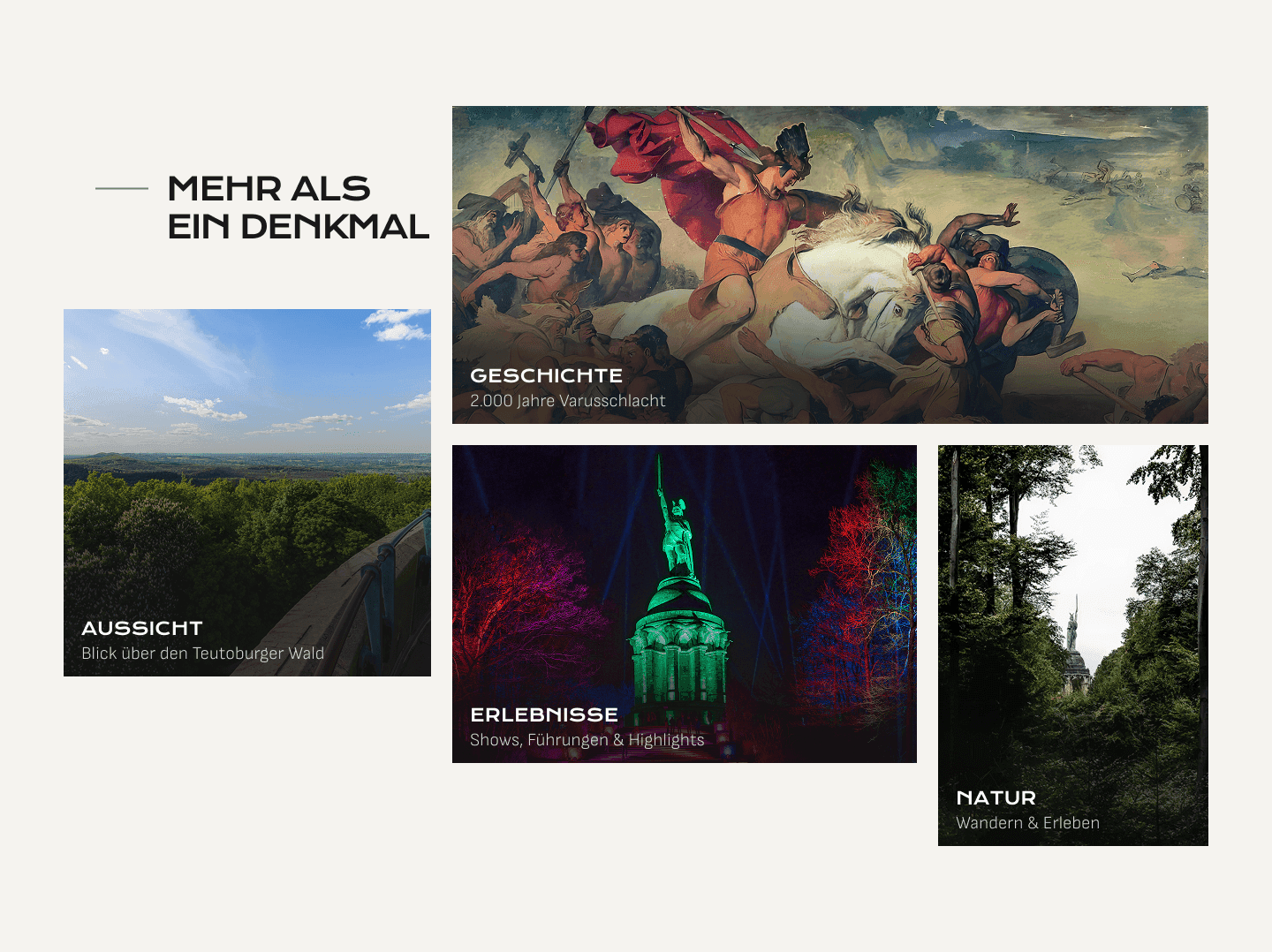
The concept presents Hermannsdenkmal not only as a landmark, but as a story visitors can explore.
History becomes more accessible through interaction, context, and digital immersion.
The monument feels closer before the physical visit.
The concept presents Hermannsdenkmal not only as a landmark, but as a story visitors can explore.
History becomes more accessible through interaction, context, and digital immersion.
The monument feels closer before the physical visit.
The concept presents Hermannsdenkmal not only as a landmark, but as a story visitors can explore.History becomes more accessible through interaction, context, and digital immersion.The monument feels closer before the physical visit.
connected visitor journey
Planning, booking, and exploration are combined into one clear experience.
The result is a more intuitive path that supports both first-time visitors and tourists.
Users can move from curiosity to action with fewer steps.
Planning, booking, and exploration are combined into one clear experience.
The result is a more intuitive path that supports both first-time visitors and tourists.
Users can move from curiosity to action with fewer steps.
Planning, booking, and exploration are combined into one clear experience.The result is a more intuitive path that supports both first-time visitors and tourists.Users can move from curiosity to action with fewer steps.